
“You’re not a girl,” exclaimed Harry, noting the badge on my shirt reading ‘birthday girl,’ “you’re a woman.” It is certainly beyond doubt that I am, in fact, female. As long as I can remember, there have been boys’ toys and girls’ toys, along with toys that weren’t aimed at either gender specifically (or at least not exclusively). GI Joe (I’m American) were boys’ dolls (or ‘action figures’ – we wouldn’t want boys to play with dolls, now….) and Barbies were firmly aimed at the girls.
Yet there always were crossover toys when I was growing up – toys that may have often appealed more to one gender than the other but were targeted at children, rather than sex[1]. Lego is perhaps the most famous of these. At its simplest, it is a collection of coloured bricks that allow children to use either instructions provided or their imaginations to create whatever their skill, the blocks and their creativity will allow. It encouraged co-operation among siblings (and not a few fights, I suspect), co-ordination, reading and interpretation skills and more.
When I was a wee lass, the blocks were black, white, red and blue with maybe a smattering of green. Lego appealed to many ages,  all genders and were the cause of many a sore foot (try stepping on one). Even the advertising in the way-back-when highlighted the universality of the system.
Much has been written about the increasing gender-specificity of toys in general and of Lego. More recently, a few clever data people looked at the colours of the bricks (rather than simply the advertising). 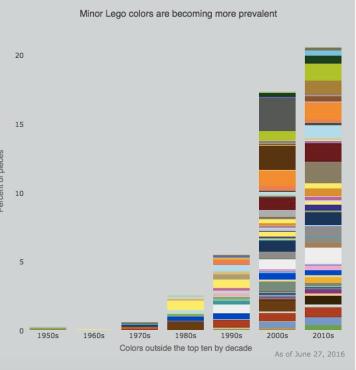 The palate has changed over the years. Greys have become more popular of late, thanks, in large part, to the introduction of movie tie ins. Let’s face it, the ships in Star Wars are mostly grey and black.
However, in the 90s, Lego began marketing a line specifically for girls. It is as this point pinks and purples start appearing (link: https://www.flickr.com/photos/126975831@N07/15801189140). By the time the 2000s roll around, the various shades of pink make up a small but significant proportion of the ‘minor’ colours, yet appearing only in sets marketed at girls.
For some people, this is a giant ‘so what’ revelation. So sets of Lego have been marketed to appeal more to ‘girly’ girls? And…some might think…the big deal is? For girls interested in technology, science, building or any of the traditional boys’ pursuits, this is indeed quite a big deal.
The girls’ sets contain more pre-made figures (of people, animals etc), are often more ‘instruction’ based and less imaginative. Indeed, some critics have noted the reduced complexity of the actual building element of the toy, that many parts, such as (the very girly) action figures (are they dolls, now they’re targeted at girls? The jury is out!) require no construction at all. The girls depicted in the sets are very girly and engage in typically female pursuits – singing, getting their hair done and the like. World building is not an aim with this range – you build the salon and see yourself (via the dolls) in it. The instructions are clear and the setting is obvious.
These toys not only reinforce the pinky-purple stereotype but also specifically exclude boys from their world. Stereotypes are not necessarily evil in themselves, of course. There will always be girls who fall firmly into the feminine stereotype and that is ok. There will always be boys who fancy themselves firemen and have no room for girly stuff in their lives. But many children fall somewhere between those two extremes. There will be girls who like wearing tutus and Iron Man masks (often at the same time). There will be boys who want to bake with their parents before climbing the next tree. Extremely gendered toys discourage that.
The thing is, if you’re the parent of a girl who is happy to play with the traditional sets – who wants to build from her imagination with her brothers or her friends, that’s fine – that’s what you’ll probably buy her. But what about her aunts, friends, grandparents who will simply visit the girls’ aisle in the toy star and come out with a Lego Friends pink and cloying set. Conversely, it is a bad thing that some girls prefer the saccharine candy floss of the Friends line?[2] No, it’s not. But these children are being actively encouraged, thanks to toys like these, to choose a role and to stick to it. Girls won’t build worlds with their brothers and some boys would rather die than be caught with a pink and purple unicorn.
Needless to say, the fact that Lego produces a girls’ range is not the end of the world. It will not, single-brickedly prevent girls from becoming doctors, coal miners, engineers, or technicians. Lego is also not the only manufacturer guilty of increasingly splitting its range between genders. It is, however, ironic that in an era where we are becoming more aware of gender issues, fluidity and glass ceilings, that the next generation is being ever more pigeon-holed into outdated views of what they should be. – by Kate Gowers @MattyGroves
[1] I do find it interesting that ‘cross gender’ toys are almost always seen as boys’ toys that girls will like, rather than the other way around. I fear there is still societal anxiety about boys becoming ‘sissies’ or something, but that’s another article for another day.
[2] No prizes for guessing which side of the fence I sit on!
 twittcomblog